USA Today: Working out of a ‘third place’ — An estimated 30 million Americans, or roughly one-fifth of the nation’s workforce, are part of the so-called Kinko’s generation, employees who spend significant hours each month working outside of a traditional office.
It’s not too late to be a genuis
Creating Passionate Users: What kind of genuis are you — An economics researcher named David Galenson (a late-bloomer himself) plodded along for years and eventually discovered a way to reverse-engineer creativity… finding that creative innovators come in two flavors: Conceptual and Experimental. Conceptual innovators, it seems, get their Big Ideas out early, many peaking out before they leave their 30’s. They can change an industry (sometimes the world) almost overnight. Experimental innovators are those who quietly crunch along, doing creative trial and error but staying largely under the radar until much later, often having no visibility until their 50’s or beyond. Oh good. I can start being a genuis tomorrow.
Recall: Sept 24 – 30, 2006
Pew Internet & American Life Project: More Americans turn to the internet for news about politics — On a typical day in August, 26 million Americans were using the internet for news or information about politics and the upcoming mid-term elections.
NY Times: The Ascent of Wind Power — Wind power is emerging as an alternative in fast-growing countries like India and China that are avidly seeking new energy sources.
Recall: week of Sept. 25, 2006
Chicago Tribune: For retirees, health-care cost increases add to pains of aging — Geraldine Picha knew that her pension would be modest, given her tenure of 15 years at the phone company. What the Chicago-area resident did not expect was that her retiree health premium would eat up every penny of that pension–and more.
NY Times: Arbiter of Style and Grammar Goes Online — The Chicago Manual of Style will be available online by subscription, freeing users to consult it ?on the fly.
Wired News: It Is ‘One Small Step for a Man’ — An Aussie computer programmer downloads Neil Armstrong’s historic “one small step for man” declaration from his 1969 moonwalk. Sound-editing software shows Armstrong got it right in the transmission from the moon.
Wired News:Peek at NSA’s Secret Reading List — What’s the typical U.S. spook reading up on? From encryption to extraterrestrials, recently divulged documents offer a glimpse between the covers of the National Security Agency’s classified internal magazines.
Journalism.co.uk — How to: avoid back pain while at the computer and How to: Set up and run a successful blog
Survival kit in an Altoids tin
Field & Stream: Make a Survival Kit out of an Altoids Tin (and Two More Life-Saving DIY Projects)
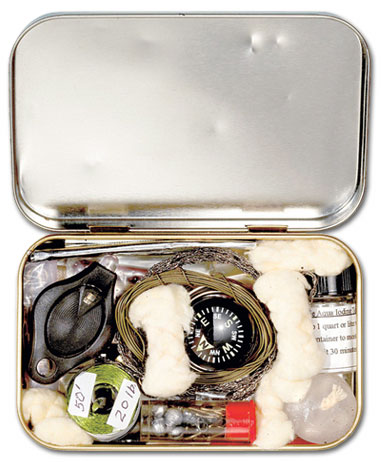
Also: Try Field & Stream’s survival skill quiz.
Recall: week of Sept. 18. 2006
NY Times: Click Fraud Is Growing on the Web — Pay-per-click advertising fraud is becoming more pervasive as spurious clicks can be generated through automated programs.
USA Today: Teens turn to TV, Internet for news — Half of all high school students get news online at least once aweek, but teens rate TV the easiest-to-use news source – and the most accurate, says a study out Friday.
Lost Remote: Gamers are a targeted marketing gold mine — Roughly 17 percent of the adult population are console gamers. They consider themselves trendsetters and consume an above-average amount of media according to a new study by Universal-McCann. They are also acceptingof product placement in moves and television. The study said that the media consumption habits of console gamers, combined with their feelings toward advertising, make them a good target for marketers.
Christian Science Monitor: Eons: ‘MySpace’ for the boomer set — Seniors are logging on to Eons.com and discovering the world of online networking. Add to that Facebook opening itself to anyone. Will there be anyplace on the internet that teens can hang out? See: Knowledge@Wharton — Losing Their Cool: The Downside of Expanding Hot Social Networking Sites — The problem: The move could be risky if it blurs the company’s focus and dilutes its brand.
Washington Post: If Only We Knew Then What We Know Now About Windows XP— If Microsoft had known it would be living with XP for so long, itshould have pushed back its release to fix some of those problems.
Butcould it have known how bad things would get? Could anyone? The reviewof XP that ran under this byline five years ago never even used theword “security.”
Lifehacker: Seventeen things every freelancer should know — Veteranfreelance illustrator Megan Jeffrey lists 17 things she’s learned overthe 17 years she’s been self-employed.
Journalism.co.uk: How to: avoid back pain while at the computer
USA Today:Blogs put businesses on Web search map — Huntingfor ways to boost revenue, a growing number of small businesses areadding another weapon to their marketing arsenal. Good one to check out: Lincoln Sign Co. — Signs never sleep blog.
Recall: August 2006
Pew Internet & American Life Project: Bloggers: A portrait of the internet’s new storytellers — A national phone survey of bloggers finds that most are focused on describing their personal experiences to a relatively small audience of readers and that only a small proportion focus their coverage on politics, media, government, or technology. Blogs, the survey finds, are as individual as the people who keep them. However, most bloggers are primarily interested in creative, personal expression – documenting individual experiences, sharing practical knowledge, or just keeping in touch with friends and family.
Looking back at Legionnaires outbreak
NY Times: The Doctor’s World: In Philadelphia 30 Years Ago, an Eruption of Illness and Fear — It took six months and an investigation with a number of twists and turns to determine what made many American Legionnaires sick in 1976.
Recall: July 2006
TechWeb: Six Things You Didn’t Know About Linux: A Beginners’ Guide
Linux.com: Ten tips for new Ubuntu users
NY Times: News Online Seems to Have Long Shelf Life — A new research paper seeks to answer a riddle for publishers, editors and even readers: when does new news become old news?
CNet: Viewing America in high resolution — A cross-country tour with a custom-built camera aims to capture the U.S. in staggering digital detail.
Wall Street Journal: Marketers Give Email Another Look — Several companies are tapping technology aimed at tracking how people read what is on a computer screen. The technology, called “heatmapping,” can tell marketers what parts of their emails get the most attention.
Columbia Journalism Review: Weird Science: Why editors must dare to be dumb
NY Times: Maybe We Should Leave That Up to the Computer — A professor has been studying the decisions that managers make, and is convinced that computer models can do a better job of it.
NY Times: David Carr: A Sideline That Competes With a Byline — Some reporters have stared down grim realities of the news business and decided that there may be opportunity amid all the mayhem.
Recall: June 2006
Wall Stree Journal: Perpetrator Problem: It’s Hard to Run Away In Falling Trousers — Cops Say Loose, Baggy Jeans Trip Up Many a Thief; ‘Hey, Dude, Buy a Belt’
Washington Post: New Sites That Make Old Functions Easy — If you grind away in Microsoft Office for a living, the idea of a spreadsheet, word processor, photo editor or calendar that exists only as code on a Web page might seem ridiculous and New York Times: Your Money: Now, Free Ways to Do Desktop Work on the Web