First NY Times, next WSJ …

The NY Times drops Times Select. Lost Remote’s Cory Bergman: Times Select has been the great experiment in premium newspaper content (the WSJ is a different animal). So does this put a nail in the coffin of the premium online news model?.

NY Times’ action leads to speculation that Rubert Murdoch will open even more of the Wall Street Journal. Will Murdoch be putting money in my pocket?

Also: Lost Remote: Learning the right lesson from the Times Select experiment, which includes the end of CNN’s Pipeline:

Times Select believed that people would pay for its writers because it is “The Times.” CNN believed people would subscribe to its video service because it’s “CNN.” This is no different from stations and newspapers believing that people will visit their sites because they are “the news channel” or they have “the brand” for trust. The fact is that the information rules.

On the Web, you can’t assume your offline brand means anything. That’s especially true when there is so much information that is so similar to your own. (Admit it.) Learn the lesson from Times Select — the right lesson. No — not that people won’t pay you anything. The lesson is that you have to rethink your brand and what it means to meet the online audience on their terms.

Lost Remote: Will wsj.com go free? Should it?

USA Today now 25

NY Times: At 25, ‘McPaper’ Is All Grown Up. Most journalists criticized its glibness, its charts and its style of coverage. Now more papers have adopted the look and USA Today has also turned more serious growing in respect. It’s now the largest-circulated daily newspaper in the U.S. with 2.3 million surbscribers (a large chunk still from hotel subscriptions) and it’s been making money for about 15 years, though not at the profit margin of other papers. One industry-wide impact from USA Today — most daily papers now have large weather maps.

McClatchy reports a drop in online ad

One month does not make a year, but I was surprised to read in PaidContent.org that while most newspapers and other news media saw in increase in online advertising in August, McClatchy reported a 3 percent drop in online advertising. Peer papers such as Lee and Journal Communications reported gains as did most other online new organizations. Given that, it’s not surprising McClatchy also reported a drop in print advertising — mostly from a drop in residential advertising.

Maybe Europeans automakers should be more worried

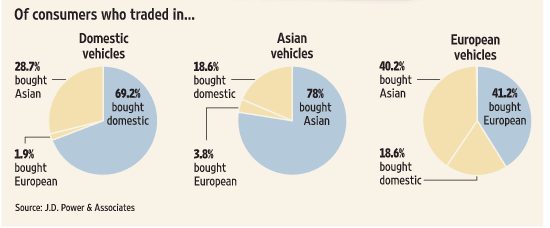
The Wall Street Journal had a story in the Friday print edition Detroit Auto Makers Try Some New Tricks on how difficult it is for domestic automakers are having trouble convincing new car buyers despite improvements in quality and design. The chart below is a portion of a chart in the paper:

wsj_chart.gif

This shows that 69 percent of owners of a domestic vehicle bought another domestic vehicle. What caught my eye was how low the percentage of owners of European vehicles who bought another European vehicle — 41 percent.

“The Human Factor”


Read: “The Human Factor” by Graham Greene — Rather than a last-minute mad dashes to save the world, “The Human Factor” looks at the lives of a settled agent, his wife and her child and the moral issues the agent faces. In his mind he’s not betraying his country, but in the end we see that he saw only part of the picture. His bosses and others were playing different games. I liked the book, but it helps to have an appreciation of life during the Cold War. “Human Factor” entry in Wikipedia.

Social networking for those who have passed milestones

A day after the story about Eons.com cutting staff, (Maybe baby boomers don’t want social networking), is a piece in today’s NY Times: New Social Sites Cater to People of a Certain Age. Besides eons, there are others, including Rezoom, Multiply, Maya’s Mom, Boomj, and Boomertown.

Social networking has so far focused mainly on businesspeople and young people because they are tech-savvy and are treasured by Madison Avenue.

But there are 78 million boomers — roughly three times the number of teenagers — and most of them are Internet users who learned computer skills in the workplace. Indeed, the number of Internet users who are older than 55 is roughly the same as those who are aged 18 to 34, according to Nielsen/NetRatings, a market research firm.

Measuring the web with 20th century methods

Mark Glaser, writing in MediaShift, takes companies such as Interactive Advertising, Nielsen, and others, over the wide range of methods for measuring traffic and the flaws associated with the varied methods. Part of the issue is what do you want to measure: page views, unique visitors, time on site, all of which can be manipulated to make numbers better. How do you measure: IP address, cookies (making users like me 3 or 4 unique visitors per day). He makes a mention of a new company Quantcast, which has different ways to measure.

The deciding factor will be which measurement the advertisers trust. Glaser’s piece was in two parts (1, 2 )