Outliers is fascinating

outliersOutlier’s may be Malcolm Gladwell’s best book. It is much more intresting and informative than Tipping Point, the book that brough him worldwide attention.

Outlier looks at factors that contribute to success, under his belief that success isn’t something almost magical — where anyone through hardwork, perserverance and some good luck can be successful. Success is based on hard work — lots of it — and other factors, including the culture one is raised in and other factors including period when one was born. For Canadian hockey players, for example, the time to be born is the first quarter of the year.

This book will create discussions about points in the book, such as the value of year-round school compared with big summer vacation schools and if Southerners still have the society of honor as much now as a few decades ago.

Dial-up stays alive — reading around Feb. 26

WSJ: Postponing Dial-Up’s DemiseThe demise of dial-up Internet access has been stymied as the recession has increased demand for a slower but cheaper way to surf the Web.

Footnoted.org: More investigations for Office Depot… — first the states were investigating it over its pricing policy. Now the feds are.

All Things Digital: Buying Spree, The Sequel: Why Not IBM/Sun, Google/Twitter, Microsoft/Anyone?

Newspapers are doing OK; it’s the publishers who are hurting — reading around Feb. 25

Ad Age: It’s Not Newspapers in Peril; It’s Their Owners: Dailies Still Make Good Money, but Debt-Laden Publishers Post Losses

“Not a lot of papers are operating at a loss,” said John Morton, the veteran industry analyst. “There are roughly 1,400 daily newspapers. We only hear about the top markets. That leaves at least 1,300 papers out there.”

All Things Digital: Upside at the Washington Post: At Least Web Ads Didn’t Disappear Last Quarter

Online revenue was up five percent, and display ads were up 10 percent. Both of those numbers represent decelerations from Q3, when overall online revenue was up 13 percent and display was up 32 percent. But that’s better than the folks over at the Times, who saw online ads shrink altogether in Q4.

WSJ: Online Ad Spending Seen ShrinkingInternet advertising could fall 5% in the current quarter, research firm IDC said, the first decline since the dot-com bubble burst in 2001.

ReadWriteWeb: Just Work Please: Mainstream Media Meets the Fail WhaleABC may have to weather a bit of snark for it, but it’s a great learning experience for them. And a testament to the sheer volume of users who share their opinions via Twitter – and the potential the service holds.

Wired: Google Joins EU Antitrust Case Against Microsoft and Mozilla too, Silicon Valley/San Jose Business Journal: Google, Mozilla line up against Microsoft

Wired: Toyota Wants to Build Car From SeaweedAs Toyota looks towards a greener future, it is exploring ways of using plastic derived from plants such as seaweed. They think it’s only a matter of time before automakers use bioplastics to build ultralight cars that take less petroleum to make, and less petroleum to drive.

seawood_toyota

How quants got us in this mess — reading around Feb. 24

Wired: Recipe for Disaster: The Formula That Killed Wall StreetIn the mid-’80s, Wall Street turned to the quants—brainy financial engineers—to invent new ways to boost profits. Their methods for minting money worked brilliantly… until one of them devastated the global economy.

Calculated Risk: Fed: Delinquency Rates Increased Sharply in Q4 — Commercial real estate delinquencies are rising rapidly, and are at the highest rate since Q2 ’94 (as delinquency rates declined following the S&L crisis).

WSJ: Employers Hit Salaried Staff With Furloughs

WSJ: Defaults by Franchisees Soar as the Recession Deepens — Some franchise brands had loan default rates of more than 40%.

WSJ: So, You Want to Be an Entrepreneur We spoke with entrepreneurship researchers, academics and psychologists to come up with a list of questions you should ask yourself before making a big leap.

Index funds win by watching costs — reading around Feb. 23

NY Times: The Index Funds Win Again — A new study provides evidence to invest in simple, plain-vanilla index funds, whose low fees often lead to better net returns.


WSJ: Consumer-Goods Makers Heed ‘Paycheck Cycle’ — Makers of household goods and food are paying more attention to the “paycheck cycle” as cash-strapped consumers are showing a tendency to make their largest purchases when their salaries first come in.

WSJ: Payments Drag Out on TV Spots — Some of the biggest advertisers are putting the squeeze on companies that produce and broadcast their ads, as part of an effort to rework contracts to cut costs.

Washington Post: Anchors Oblige Public’s Craving for Tweets — But one must ask: Would Walter Cronkite have tweeted?
Washington Business Journal — Free soft drinks return to US Airways. No word if free blankets are returning.

WSJ: Philadelphia Inquirer Publisher Files for Chapter 11. Over the weekend it was Journal Register, see WSJ: More Newspapers File for Chapter 11.
Using information from a federal lawsuit and additional reporting, the Charlotte Business Journal has taken a detailed look at that one bet — called a credit-default swap, which is similar to an insurance policy. The broad sweep of entanglements in that $10 million deal opens a window into the complex world of exotic Wall Street finance, illustrating what has happened in the national and world economies on a much larger scale.
TechCrunch: Hot News: The AP Is Living In The Last Century — Basically, the judge says the AP can try to prove AHN stole it’s “hot news”. But what constitutes “hot news” in an age of instant communications?
Interesting issue. Does AP have a business model, which means paying reporters to cover the news, if they can’t protect “hot news?” But how long can a story stay hot news rather than news, which cannot be protected?
Wired: Rare Comet Close-Up Coming to a Sky Near YouComet Lulin will make get close enough for anyone with binoculars and a clear sky to see on the night of Feb. 23. NASA’s Swift Gamma-ray Explorer satellite got a great photo during its own close-up with the comet last month.

Stimulus spending data through RSS — reading around Feb. 22

ReadWriteWeb: Stimulus Spend Data Coming via Feeds

ReadWriteWeb: The Next Node on the Net: Your Car!

Bloomberg: Bond Trading Highest Since ‘07 as Credit Freeze Thaws

Corporate bond trading is accelerating after the recession pushed investment-grade yields to 9.3 percent in October, the highest in 17 years, according to data compiled by Merrill Lynch & Co. Investors are betting yields are high enough to compensate for defaults that Moody’s Investors Service forecast will rise to 16.4 percent by November, the highest since the Great Depression and about three times the current rate.

Skill in geocaching

One thing I’m enjoying about geocaching is the cleverness of those making the treasures for the rest of us to find. This one is a good example. Here’s what I was looking for:

three-sticks

And here’s how it was prepared for geocaching:

stick-with-hole

“The Curious Case of Benjamin Buttons”

benj_buttonsAs part of birthday present, we went to see it. I knew it had 13 Oscar nominations, and I knew the story line, and I still came out of the movie excited abou it. A very good movie with an interesting story line and special effects. Glad I saw it.
I wonder how many Oscars it will win?

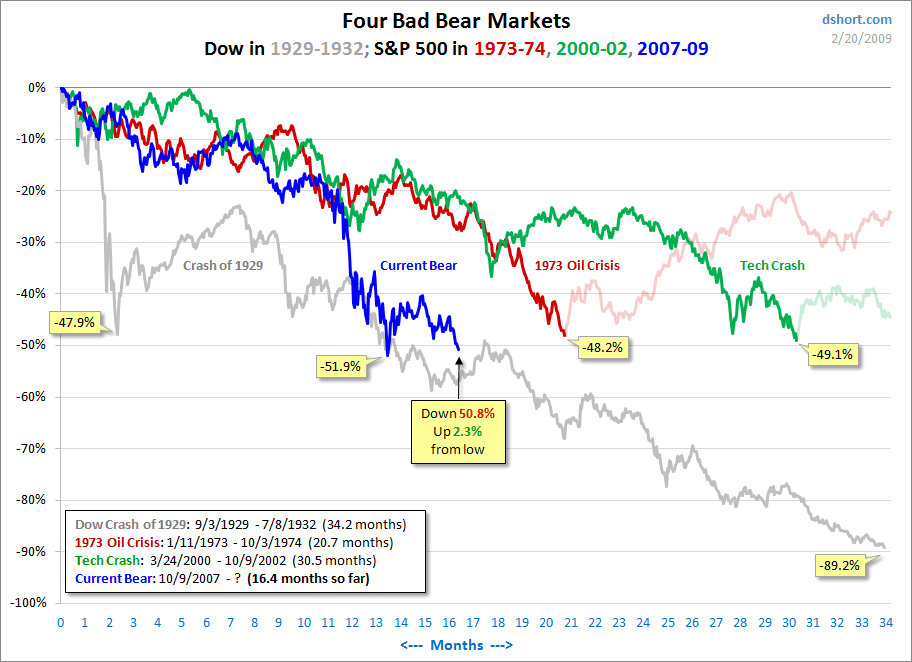
Four Bear Markets update — reading around Feb. 20

four-bears-large

from Dshort.com

WSJ: The Day the Muzak Died: Remembering a Soundtrack to LifeI can remember the precise moment when Muzak first pierced my awareness, letting in the notion of an adult universe in which the cool and the uncool do perpetual battle.

WSJ: Parents Give Up Facebook for LentAs Lent approaches, some parents are mulling a choice they’d have once seen as preposterous: A Facebook fast — not for their teens but for themselves.

Calculated Risk: U.S. Vehicle Miles Driven Off 3.6% in 2008

Chris Brogan: How Not to Market on Twitter and Build Blog Posts Like Building Blocks

Carter on Great Depression vs. now — reading around Feb. 19

Atlanta Business Chronicle: Carter: No comparison between Great Depression and today

“There is no comparison to the Great Depression and where we are now,” he said. “The Great Depression was much more severe. Right now, we have 7 percent unemployment. In the Great Depression, it was four times that. Back then, there was no money.”

All Things Digital: Google’s Plan To Save Newspapers: Make Them Look Better

All Things Digital’s conclusion: I think that the best place for newspapers to start is by cutting costs and generating more revenue. But maybe I’m missing something. Would a better-designed New York Times site make you more likely to, say, pay for a subscription to the New York Times? Let me know.

WSJ: Local Web-Ad Market Cools DownGrowth in the local-ad market is expected to shrink, challenging the ad and media-buying shops that rely on the local Internet market.

Time: 25 Best Blogs 2009 – TIME