From Wall Street Journal: Finding out if folks are still-crazy after all these years. Eddie Dean reviews Max Watman’s Chasing the White Dog: An Amateur Outlaw’s Adventures in Moonshine
 Philadelphia Business Journal: Former First Savings CEO Hollenbach tells his inspiring tale in new book
From Yelvington, The first rule of coding for Drupal:
This is a message to prospective Drupal developers. I’m going to propose this as the First Rule of Coding for Drupal: We do not write code for Drupal.
In the post, he also mentions the J-learning site Newspaper in a box by Mark Briggs, a guideline for starting a newspaper from scratch and without Web consulting.
Recently Portfolio.com profiled an executive of a new business start-up who described how inexpensive the cost to build a web site are:
I’ll even put numbers on it: What cost a minimum of $500,000 and took nine months and lots of engineering talent in 2004 can be done today, thanks to technology changes, by smart people with some Web awareness or the willingness to learn, for less than $20,000 in three months. It’s not that we’re doing this business on duct tape and baling wire, either. We’re working with very clean, professional services that can scale and which just a few years ago cost a hundred times as much to put in place.

What The Dog Saw by Malcolm Gladwell
“What the Dog Saw: And Other Adventures” is collection of Malcolm Gladwell‘s New Yorker pieces and hits squarely on a quality I love in books — it makes me more curious and questions what I think I know. Those qualities are things I love about journalism and non-fiction writing.
It covers everything from the cloud of information prior to the 9/11 attacks and Enron to how to choose NFL quarterbacks.
Gladwell’s books (I read Outliers earlier this year and Tipping Point long ago.) are easy to read, making a book to read while traveling or waiting for an appointment. This latest book now makes me want to read SuperFreakonomics by Stephen D. Levitt and Stephen J. Dubner.
Lost Remote: When “good enough” journalism is better — which version do you like best — version 1 or version 2.
From the reporter who did version 1:
You can certainly argue that their story is better than mine, but does the small increase in quality justify the significant increase in costs, especially when the money isn’t there to spend?
New Yorker: Priced to Sell Is free the future? — In Malcolm Gladwell’s review of Chris Anderson’s new book “Free: The Future of a Radical Price”, the value of free — as in no charge for content, no charge for use. It’s a big issue for newspapers, but others are affected too. Best example from Gladwell is YouTube, which is paying more for bandwidth and technical costs than it is making in advertising. Why don’t advertisers want to be on this category leader? They don’t want to be associated with most of the content created by volunteers.
The Seattle Courant: Thanks, Everyone — an online-only newspaper in Seattle folds.
Why?
The Courant failed because I didn’t have enough cash and I didn’t find someone who could handle the business side, such as finding customers, technologists and managing projects. The trick I had to pull off was to be able to fund the Courant while I not only built a newsroom, but also a technology firm to support it. I couldn’t do it all.
But for those who believe hyper-local is a sure thing, the Courant’s founder, Keith Vance, is less sure:
My advice to anyone who seeks to create something like The Seattle Courant is to make sure you have at least enough money to get you through the first year and someone who’s as committed as you are to the business. To generate revenue, focus your efforts on providing technology solutions to your customers and not just selling banner ads. You have to be able to do something that other people can’t, or don’t want to do. Going to city council meetings and covering press conferences counts as something people don’t want to do, but news doesn’t make money it costs money. One way to think of it is that instead of a print shop that supports a newsroom, we need to build a technology firm that supports a newsroom. It’s really not that different, it just requires a different skill set.
WSJ: Ivy League Endowments Finally ‘Dumb’
The fiscal year for most endowments ends Tuesday and nearly every one has had big declines, but smaller endowments are poised to outperform heavyweights like Harvard University and Yale University by significant margins. Endowments with less than $1 billion generally held up better by putting more money in fixed income and less in alternative investments like hedge funds.
WSJ: Ruth Faces Living Off a Scant $2.5 Million — Ruth Madoff that is
Washington Post: Media Notes: Howard Kurtz on Nick Denton, Founder of Gawker
“We don’t seek to do good,” says Denton, wearing a purplish shirt, jeans and a beard that resembles a three-day growth. “We may inadvertently do good. We may inadvertently commit journalism. That is not the institutional intention.”
Lost Remote: Huffington Post’s local rollout continues — Huffington Post will launch a New York local aggregation site today, followed soon by Denver and other major markets.
WSJ: Easy Way to Log In Face Time — The easier it becomes, the more who will use it.
WSJ: GPS Satellite Glitches Fuel Concern — more reasons I won’t be able to find geocaches.
Lost Remote: Google expanding Street View to (hiking and biking) trails.
The entertainment and media sector are not expected to see a recovery until 2011, according to latest reporter on the industry from PriceWaterhouseCoopers, as reported by Paid Content.
Advertising revenues as a whole are facing a period of broad decline over the coming five years, with global advertising spend across all media projected to be still below its 2008 level in 2013. This means a “profound structural shift during the five years towards more targeted and cost-effective ad models enabled by digital. This in turn may result in a permanent reduction in total advertising spend, as dollars formerly ‘wasted’ through inaccurate targeting are saved and reallocated to other priorities,” says the report.
Paid Content: Entertainment & Media Sector Recovery: Might Have To Wait Till 2011: PwC
Paid Content: BusinessWeek Readies Another Site Redesign, With E-Paper Paid Version
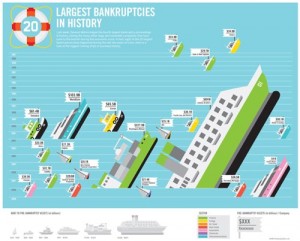
Nice infograpic on the largest bankruptcies by Transparency.